Railway to evict 250 squatters in Jaffna
by Ananth PALAKIDNAR
The Rai lway Department with the assistance of the Government Agent, Jaffna has taken steps to evacuate over 250 squatters occupying Railway property in the Jaffna peninsula.
A top level team of Railway Engineers led by Superintendent V. Amaratunge visited Jaffna to evaluate the damage caused to the CGR in the past three decades.
Engineer Amaratunge told the Sunday Observer that a Herculean task lay ahead of the CGR in rebuilding the railway in Jaffna.
"The CGR team of engineers had travelled 59 kms from Kankesanthurai to Palai to conduct a feasibility study on relaying the rail tracks to the peninsula.
We found that 250 squatters had occupied the areas where the railway tracks were in the past.
The squatters had also occupied the railway stations in Inuvil and Kondavil.
Therefore, the CGR has sought the assistance of the Government Agent, Jaffna to evict those encroachers from the railway property", Amaratunge said.
He said that fourteen substations and fourteen main stations including the Jaffna Railway station have to be reconstructed on the Northern line.
sundayobserver.lk
Sunday, July 5, 2009


The expatriates:The need of the hour for their kith and kin is the resettlement and peaceful living in their original places...!!!
Supports President’s initiative to rebuild war-torn North:
Tamil expats take LTTE’s henchmen to task
by Ananth PALAKIDNAR
Plans for a ‘Transnational State’ by the now defunct LTTE - their henchmen such as Kumaran Pathmanathan and V. Rudrakumar came under severe criticism by a majority of Sri Lankan Tamil expatriates according to the DAN (Dish Asia Network) TV station based in Paris. The Chairman of DAN S.S. Kuganathan told the Sunday Observer that a survey was conducted by his television on the collapse of the LTTE and the plans by the outfit’s henchmen to create a ‘Transnational State’ was conducted in Europe and the Middle East last week among Tamil expatriates.
More than ninety percent of the DAN viewers who had participated in the survey and expressed their views had severely criticised the LTTE and the future plans of its henchmen to create a ‘Transnational State’, according to Kuganathan. “We first broadcast Kumaran Pathmanathan’s announcement of his ‘Transnational State’ and invited the viewers to comment on it.
The viewers castigated Kumaran Pathmanathan saying to leave their people to live in peace and to get lost instead of meddling with the lives of innocent civilians in the North and East,”Kuganathan said. One of the viewers said that the expatriate Tamils had been misled by the LTTE and its stooges for decades and that their sole motive was collecting money and nothing else. The expatriates said that the need of the hour for their kith and kin is the resettlement and peaceful living in their original places.
The expatriates also expressed their support to the initiatives taken by the Government of President Mahinda Rajapaksa in rebuilding the war-torn North.
Another viewer said that by carrying out a separatist war in Sri Lanka the LTTE had shattered the lives of a countless number of Tamils and now by attempting to continue with their activities in exile the outfit’s henchmen were trying to make the lives of the expatriates miserable abroad, Kuganathan said.
sundayobserver.lk
Fmr LTTEers: Most of them have a firm belief in a benevolent God, who will take care of their troubles...!!!


Major.J.Suraveera
Getting back their lives
Ex-LTTE cadres talk about their past , present and hopes for the future
By Chathuri Dissanayaka and Thulasi Muthunayagama in Welikanda, Pix by Saman Kariyawasam
Tiger guerrillas wanted the 15-year-old daughter of the house, but the family could not bear to part with her. However, since one child per family had to be “sacrificed” to the movement, 17-year-old *Rajah volunteered to take the place of his sister.
He was trained for 20 days in the use of weapons and then sent to the warfront. That was in 2006.
“I grew up in Jaffna, I was simply at the wrong place at the wrong time,” says the youth who has still managed to retain an air of innocence and gentleness after all he has been through.
Major Suraweera
His family was trapped in the Wanni until recently and Rajah managed to rejoin his family and flee to government-controlled areas.
They escaped together from the no-fire zone but got separated when they scattered to avoid being shot by desperate LTTE cadres who were firing indiscriminately at the escapees. Ever since his 16-year-old brother has been missing and Rajah fears that his brother may have been killed in the firing.
Rajah, his parents and his two sisters managed to flee and make their way to the Arunachalam camp in Vavuniya. Rajah surrendered on his own accord to the army and was brought to the Welikanda Rehabilitation Centre in Polonnaruwa.
His mother passed away on April 22 of a contagious fever at the IDP camp. He was not allowed to attend her funeral as the rules require an inmate to stay within the rehabilitation centre premises for one year. He has had no contact with the rest of his family in the IDP camp and he has now received a letter informing him that his father and one of his sisters have also fallen prey to the same fever that took his mother away.
“When they tried to come out of the camp to visit me they were refused permission. They know where I am, I wish they would at least call me,” he said.
He, like many others in the camp, speaks well of the facilities and how they are treated by their trainers but they are unhappy that they have to live far apart from their families for a long period.
“If we have to be sent to rehabilitation centres, at least send us to ones closer to home so that our relatives can visit us,” was the plea of many, including Rajah, as coming to Polonnaruwa is beyond the means of most of their families.
Major B. P. Jayalal Suraveera, commanding officer of the centre has already made inquiries regarding the possibility of sending Rajah to the camp in Tellipalai, in Jaffna.
Learning Sinhala: Outdoor classes for the inmates
“Rajah has already made a request in this regard and we are trying our level best to accommodate his wishes,” he said.
As if long starved of a sympathetic ear to hear their tales of woe, the surrendees crowded around to tell us their stories, each traumatic and pitiful but all similar — forced conscription, inadequate training before being marched off to the warfronts and fear of surrendering to the military being identified as an ex-LTTEer, although many had not joined the LTTE voluntarily. Although this fear has subsided to a great extent they now have the additional pain of having little or no information on their kith and kin in IDP camps.
Among the voices clamouring to be heard was that of *Ganesh, who has suffered injuries on his arms, head and even on his torso – all injuries from shelling. He broke down as he related how his parents died during the recent shelling and the last he knew of his four younger siblings was that they were taken to Wanni Hospital to be treated for injuries from shelling.
“Their condition was serious at that time and since then I have had no news of them. Please help me get information on where they are and how they are doing,” he pleaded tearfully. They are not only anxious about the well-being of the loved ones but they also worry that their parents must be anxious not knowing what has happened to them.
“We lack nothing facility wise here but we worry about our aged parents who are probably suffering in the camps. Some angry inmates said the LTTE should never have been allowed to treat the Tamil civilians in such a ruthless manner and terrorism of such brutality should never be allowed to raise its ugly head again.
In the last days of the military onslaught, the LTTE was so desperate that it was conscripting civilians who had just one day’s military training.
“They showed me how to open the gun and reload and that was it and they sent me into the thick of the battle,” shouted one. “I had no idea what to do, I just threw the gun and ran and somehow miraculously escaped,” he said.
About the camp
Name : Protective Accommodation and Rehabilitation Centre
Location: Senapura, Welikanda, Polonnaruwa District
Extent of camp: Seven and a half acres
Established: August 2008, to rehabilitate captured or surrendered LTTE cadres
Origin: Started with 25 inmates
Current status: 145 inmates
Progress: 189 ex-militants have completed training.
Some are obviously traumatized and need long sessions of counselling while others despite all they have gone through, manage to be positive and can’t wait to get on with their lives.
“We spent one month in custody after we surrendered before being brought here. We were terrified of how we might be treated because the LTTE had tagged us with its name even though we did not join voluntarily. But here, we are treated with kindness and respect and we have been assured that we will be able to lead trouble-free lives when we leave here. This has brought us great peace of mind,” said one inmate and his sentiments were what we heard from many others when questioned on how they were being treated.
Major Suraweera, is quite aware of the initial feelings of fear and uncertainty the inmates go through as they come to the rehabilitation centre. “We have built a Hindu Kovil, a Buddhist Temple and a Church on the premises. The first sight that greets a nervous ex-cardre as he alights from the bus are these places of worship. These help to relieve his fears to a great extent,” he said.
According to him, most of the inmates are religious in spite of, or perhaps because of, all that they have been through. “Most of them have a firm belief in a benevolent God, who will take care of their troubles,” he said adding that he always made it a point to personally welcome the new arrivals speaking to them in Tamil so that their first impression of an authoritative figure in army uniform is a good one. “This does a lot towards changing their negative impressions about us and helps to build up their trust in us,” he said.
According to the major, he strives to be both a disciplinarian and approachable friend to the inmates. The educational background of the ex-cardres is diverse, ranging from the most rudimentary to those who have qualified to enter university. The camp aims to provide them with basic education and vocational skills. However, catering to such a disparate group of people is not easy, according to Major Suraweera. The inmates are taught English, Sinhala, History, Geography and computer science. They are also given training in masonry, carpentry, house-keeping skills, so that they might have better opportunities for employment and reintegration into society once the rehabilitation period is over.
“We try to cover three main fields – basic education, vocational skills and attitudinal development. We have only one instructor. W.M. Appuhami from the Polonnaruwa Technical College, to teach the inmates carpentry, masonry and plumbing. He is not conversant in Tamil but he has managed to circumvent this issue and has established a rapport with the inmates. It would be ideal if we had instructors conversant in Tamil.
It is also Major Suraweera’s dream to have a computer lab within the premises soon. With a diploma in IT from the Kotelawala Defence Academy, he himself teaches the students computer science but there are not enough computers. “When there were only 25 inmates, I allowed them to practise on my office PC, but now the number has grown to 146 and it’s not possible.
“I live away from my family, so I consider these young men my children and do all that I can for them – from instructing and advising them as their commanding officer and teacher, to acting as a parental figure where necessary such as taking them to the doctors and generally doing all I can to ensure their well being,” he said.
It was Major Suraweera who signed in the place of a parent for the university application of one trainee, S.Ruban. He had passed his A’ Levels with flying colours but had then been forcibly recruited by the LTTE from Kilinochchi. Now he has been given a chance to pursue his dream of higher education and authorities have done all they can to facilitate the process. Ruban currently puts his knowledge to good use as editor of their in-house magazine, but hopes that a new life awaits him.
*(The names of the inmates have been changed on request)
Three cadres, three different tales
One of the inmates at the camp, *Krishna, has become so proficient in Sinhala that he is being called on often to be a translator by the trainers. The 21-year-old had been conscripted just before sitting for his O’Level exams from the Batticaloa area. He had always had a passion for IT and had planned to become a professional some day, a dream he hasn’t given up on. Unlike the others, however, he was not embittered by his conscription. He had worked in the LTTE office. He had never seen the battlefield and was not as traumatized or angry like the others.
One of the inmates leaving after completion of the programme
He has successfully completed his one year in Welikanda, where he earned the respect of his trainers and is now ready to leave to a western country where he hopes to start a new life.
One of the few members in the centre who wasn’t forcibly conscripted is *Selvam. “I was just 13 at the time (1993),” he said. “Five of us were returning from school when the LTTE called us to join it and we threw away our school bags and joined them.” Asked what had prompted him to join so young, he replied with a grin that it was just the thrill of the moment. He and his friends had found it all very exhilarating. Of the five, two have since died in action and one left the movement long ago to go abroad. The other one is also in a rehabilitation centre elsewhere. Selvam had been given intensive training for three years before being sent into battle which he claims he was not at all afraid of.
“When you are young, you don’t fear death. It was only after I got married during the ceasefire and had a daughter that I started being concerned for my life and that too was only for my wife’s and child’s sake. That’s why I surrendered, not because I wanted anything for myself but because I felt the need to ensure that my wife and five year-old-daughter did not suffer because of me. They should be allowed to lead a hassle-free life.” Selvam was a hard core member of the LTTE who rose to the position of major within the outfit.
* Pillai has just completed the one year programme at the rehabilitation centre and is looking forward to joining his wife and daughter in an IDP camp. His relatives from Trincomalee came to take him to his wife and daughter. He is all smiles at the prospect or rejoining his family, even though it is at an IDP camp. He apparently shaved his head and disguised himself to escape the clutches of the LTTE . His only concern is about possible reprisals from former LTTE cadres who may be at the IDP camp.
There should be legal process along with rehabilitation
Ex-LTTE cadres who were heavily involved in the movement’s activities should be dealt with legally, parallel with the rehabilitation process, a government official said.
Learning skills that will help them when they step out into society.
Speaking to the Sunday Times, Commissioner General of Rehabilitation Suhada Gamlath said, among the batches of cadres who surrendered in the last few weeks of the conflict, there were hard core members who were known to have shot at fleeing civilians at point blank range and others who had committed acts of atrocities.
These instances should be identified and the culprits dealt with legally as well as being rehabilitated.At present there are about 11,000 ex-cardres awaiting rehabilitation, he said.
“The process of channeling them through rehabilitation is going to be hectic,” Mr. Gamlath said, adding that the current centres were filled to capacity.
He said there were plans to open four new centres to accommodate the recent surrendees who wish to be rehabilitated. Of the four, one rehabilitation centre is to be opened at the Vavuniya Co-operative School building while another only for male surrendees, is to be set up at the Technical College building in Nellukulam, Vavuniya.
sundaytimes.lk
Recognition of Tamil alongside Sinhala as an official language guaranteed by the same constitutional amendment remains largely confined to paper...!!!
Official Languages Policy - mere rhetoric?
Even incentive payments , denial of increments have failed to stir them from their slumber
By Chandani Kirinde
While opinion remains deeply divided in the country about the full implementation of the Thirteenth Amendment to the Constitution, the recognition of Tamil alongside Sinhala as an official language guaranteed by the same constitutional amendment remains largely confined to paper with several key areas in the government sector lagging behind in executing the Official Language policy.
Lack of resources, finances, trained personnel and unawareness have contributed to the slow pace of implementation of the language policy despite attempts by the government to correct the deficiency. With the end of hostilities and the opening of more public services in the north and east, the comprehensive implementation of the language policy seems more plausible as well as timely.
“The ethnic problem was largely due to the Tamil people feeling alienated particularly over the language issue and lack of equal access to the public service. It has become an urgent need to implement the language policy, says Chairman of the Official Languages Commission Raja Collure. A recent study done by the Commission covering a population of over 3.5 million of which over 1.1 million were Tamil speaking people living outside the northern and eastern provinces found that of the 6,626 public officials of all grades working there, only 627 or 9.5 per cent were proficient in Tamil.
A similar study was conducted in the northern and eastern provinces to ascertain the availability of public officials proficient in Sinhala. Of the over 1.5 million population surveyed of which the Sinhala speaking population was a little over 365,000, it was found that only 98 or 18.1 per cent of the total of 540 public officials serving, were proficient in Sinhala. “The language issues affect both communities but it is the Tamil speaking people who are more affected as they live in large numbers outside the north and east and this includes Muslims and up country Tamils who have no proper knowledge of Sinhala, “Mr.Collure explained.
Under the terms of the Constitution, Sinhala is the language of administration in all the provinces other than the Northern and Eastern provinces where Tamil is used. The same policy is applicable as the language of the courts in the country.
The Government issued two circulars in early 2007 pertaining to the implementation of the language policy, one offering enhanced incentive payments for public servants acquiring proficiency in both Official Languages and another making it necessary for all officers recruited to the public/ provincial public service with effect from July 1, 2007 to acquire proficiency in the other Official Language within a period of five years in addition to the Official Language through which they enter the service.
Nevertheless the incentive payments ranging between Rs 15,000 to Rs 25, 000 as well as denial of increments to public officials who fail to obtain the required proficiency within the stipulated period of time have not encouraged many to take the language issue seriously with the numbers sitting the proficiency tests conducted by the Official Languages Department highly unsatisfactory. Since July 2007, the Police Department has recruited nearly 12,000 personnel of all ranks while the Health sector and the Public Administration sectors have recruited around 8,000 each but only around 2,100 sat the last Language Proficiency tests conducted in 2008.
The situation with regard to Translators too is dire with less than 130 in the Translator Service of whom only 28 are proficient in Sinhala/Tamil, 82 in Sinhala/English and 21 in English /Tamil. Here too the number proficient in the two Official Languages is extremely poor, he said.
“Our fear is that these circulars will become a dead letter unless they are adhered to strictly. It is the obligation of the state to provide for the functioning of the language policy,” the Chairman of the Commission said.
While the Commission and the Department of Official Languages are the main government institutions empowered with monitoring supervising and training to ensure compliance with the Official Languages policy, the lack of funding particularly for the training programmes has restricted the services they can render.
“The provincial councils too are expected to play a role in the implementation of the Official Languages policy but their attitudes are very unsatisfactory. The different departments too need to get money from the government and implement the policy on their own as we have fewer funds,” Mr.Collure said. With many new police stations opening up in the north after the defeat of the LTTE, it has become an even more pressing need to train police personnel who can work in both languages, the Chairman of the Commission said.
While all recruitment to the public service is merit based and no language based recruitment can be done, he recommends that an auxiliary service be set up from where the necessary personnel can be drawn to serve in offices where their services are needed until the levels of proficiency among the majority of public officials reaches a satisfactory level and they are able to discharge their duties in both Official Languages.
sundatimes.lk
Friday, July 3, 2009
De-mining and the reconstruction would go hand in hand at an accelerated pace so resettlement would take place without any delay....???!!!
Vanni rehab fast tracked....... by Franklin R. Satyapalan
An accelerated programme for the rehabilitation of all State Institutions and reconstruction of damaged roads and bridges in war ravaged districts of Mannar, Mullaitivu, Kilinochchi and Vavuniya under the Governments 180 day ‘Uthuru Vasanthaya’ programme in the Northern Province would gets underway today.
Former IGP and Presidential Advisor on Infrastructural Development of the North and the East Chandra Fernando said that Senior Presidential Advisor and Chairman of the Presidential Task Force MP Basil Rajapaksa had instructed the respective District Secretaries at a recent meeting to prepare a damage assessment report without delay.
Minister of Resettlement and Disaster Relief Services Rishard A. Badhuideen said that the de-mining and the reconstruction would go hand in hand at an accelerated pace so resettlement would take place without any delay.
Presidential Advisor and Commissioner General of Essential Services (CGES) S. B. Divaratne who is also the Secretary to the 18-member Presidential Task Force is to Chair the damage assessment meetings scheduled for the whole of today.
The District Secretary (GA) for Mannar Nicholas Pillai, District Secretary (GA) for Mullaitivu Mrs. Emelda Sukumar, District Secretary (GA) for the Kilinochchi Nagalingham Vethanayagam and District Secretary (GA) for Vavuniya Mrs. P. S. M. Charles were very busy yesterday preparing the reports.
All the Department Heads attached to the CEB, Health, Postal, Education, Cooperatives, RDA, Transport, Agriculture, sectors as well as those from the Police and the Military were instructed to submit their reports for reconstruction.
Deputy Director of Planning for the Vavuniya District Mrs. Pathma Ranjan has been instructed to carry out a survey and estimate the cost of supplying power to the four Divisions in Vavuniya as Vavuniya North, Vavuniya South, Vavuniya and Vengala Chttikulam without delay, and develop the sectors of Resettlement, Agriculture, Animal Husbandry, Palmyrah Development, Water and Sanitation and the repair of all A-4 and B-4 Highways as well as rural roads under the 160 day Uthuru Vasanthaya programme.
www island.lk
Thursday, July 2, 2009
VIOLENT ATTACK OF SINHALA JVP STUDENTS ON FELLOW SINHALA STUDENTS!!! HOW CAN JVP MAKE HARMONY IN SRILANKA...???!!!
University student assaulted by fellow students
By Kassapa Ellepola and Krishan Jeewaka Jayaruk
A female student of the Ruhuna University who came under assault by a group of fellow students in a hostel was admitted to Matara Hospital and three other students have also lodged complaints with the Matara police saying that they were assaulted by their fellow students.
The victim, a first year student of the science faculty said that she was assaulted by the members of the Students’ Union of the University.
Meanwhile the convener of the ‘Swadeena Shishya Sahayogitha Padanama’(SSSP) in Ruhuna University, Pathum Jayasekara alleged that some independent students have been assaulted by the pro-JVP Students’ Union members and that few students have been admitted to the hospital.
“The JVP affiliated Students’ Union should take the blame for these assaults. The Students’ Union is protesting for the removal of the police post established inside the university premises but we urge the authorities not to remove the police post as it would put the lives of students in danger,” he said.
He further said that the Students’ Union members are creating trouble in an attempt to close the university so that they could go and help JVP members contesting the Uva Provincial Council elections.
The Student Union members took part in a massive protest in front of the university urging the removal of the police post established inside the university.
The President of the Students’ Union in Ruhuna University Sanjeewa Mahesh said that the SSSP students are creating trouble and charged that the government is using police to suppress university students.
“Some male police officials have entered the girls’ hostel yesterday without any female police officials making them embarrassed. We see this as a violation of the law,” he said adding that the police post established inside the university should be removed from the university as it interrupts the freedom of University students.
Meanwhile the Deputy Vice Chancellor of Ruhuna University said that the police had to be called to ensure the protection of the students and the university property.
Meanwhile Matara Police said that they used women police officers when they searched the girls’ hostel and confirmed that they have received complaints from science faculty students regarding assaults.
Meanwhile the SSSP of Kelaniya University which mainly comprise of Science Faculty students urged officials to reopen the university as the closure of university has resulted in delaying examinations and also increasing course duration.
Addressing the media yesterday SSSP President Namal Kariyapperuma alleged that the Science Faculty students were not involved in the conflict which took place between the JVP affiliated Students’ Union members and the village people.
“It is the misbehavior of the of Students’ Union members that has put the lives of each university student in threat, those who had nothing to do with the fights,” he said adding that a number of science students have been also assaulted. He further said that the students involved in the fights are accommodated in the hostels inside the university and said that it is the science faculty students who live in hostels in the village that have been deprived of accommodation.
“A Permanent-Vice Chancellor should be appointed to the university to solve these problems and reopen the university as we only have an Acting-Vice Chancellor,” he said.
The University of Kelaniya was closed indefinitely due to clashes between a student faction and the village people and the university continues to be closed for the third week.
dailymirror.lk
Wednesday, July 1, 2009
Chinese Navy ships stopped at SL because it is indeed a very good midpoint in their journey to Pakistan to participate in the naval exercises...!!!
SL the theatre for another cold war-----UPUL JOSEPH FERNANDO
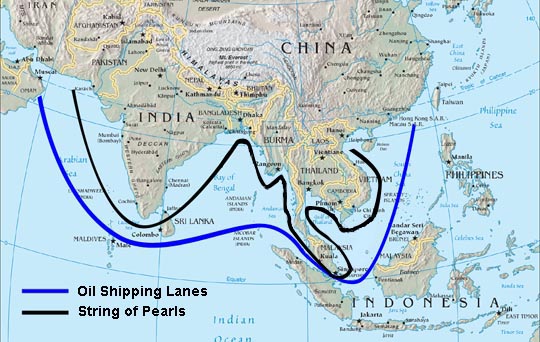
From the question posed by the media to the Chinese representative immediately after he attended the Asia Pacific Submarine conference, it is evident that Sri Lanka (SL) is once again becoming the epicenter of another global cold war of the super powers. The representative of China who attended the conference was Senior Colonel Xie Dongpie , the Deputy Director of the General office of the Chinese Navy Headquarters. To the question asked from him ‘ whether China would make use of naval facilities in SL to base its Navy ships’? .Senior Colonel Dongpie’s answer was ‘China’s naval vessels have stopped at SL Ports for refueling and replenishment of supplies , but the arrangements were purely technical. In the two years 2007 and 2009 , our Navy ships have stopped at SL because it is indeed a very good midpoint in their journey to Pakistan to participate in the naval exercises there’, he further added . There is a speculation that the Chinese may want to have use of a naval base in SL to secure sea lanes through which its energy supplies are transported. Senior Colonel Xie also declared ‘ China’s cooperation with the South Asian countries – SL, Pakistan and Bangladesh in the areas of ship building and Ports construction was purely commercial ’.These statements of Xie Dongpie have triggered speculations that China has plans to use SL’s naval facilities for China’s navy ships.
The fundamental cause of SL’s ethnic war was the Trincomalee harbour . It was Russia’s belief that America may use the Trincomalee harbour to its advantage . As this cold war escalated the SL ‘s ethnic war broke out . The ‘Blitz’ magazine of 26th February 1984 under the caption ‘US digs deeper into SL’, published an article which read thus ‘ in the implementation of its military and strategic designs in South Asia , the Pentagon attaches major importance to its positions in SL . Washington wants to fill in the gap between the US Naval base bay in Trincomalee in the north eastern port of SL. US Defense Secretary Weinberger used his recent visit to Colombo to pressurize SL to increase its involvement in America’s military , political and economic plans aimed at penetration into South Asia , undermining the non aligned movement from within this region. Informed circles say that Weinberger’s visit to Colombo was to pursue the aim of studying the possibility of moving the Head quarters of the Central command (CENTCOM) to Sri Lanka after the setting up of the US Naval base in the Trincomalee Bay……..’
This report greatly embarrassed Russia , the erstwhile Soviet Union. India also felt this embarrassment because India was alongside Russia at that time. Based on an information that America was aiming at taking control of the Trincomalee harbour, India and Russia decided against this and the Govt. of Late JR Jayewardene who was working closely with America. It was Russia more than India which was irritated and distraught over the information that America was fixing its gaze on the Trincomalee harbour. Russia was determined to somehow obstruct this purported move. Russia used India to accomplish this aim. The secret espionage services KGB of Russia and the RAW of India worked together to thwart this move – a consequence of this was the precipitation of the SL’s ethnic war .Training the Tamil armed groups of SL , providing them with arms and commencing a war in the North East were the aims of India, so that it could gain a leverage and thereby intervene in the destabilized north east . This plan worked out .When the Indo -Lanka accord was formulated , India at the behest of Russia incorporated a clause in the accord that on all matters and decisions pertaining to the Trincomalee harbour , India’s consent is mandatory.
Russia which used India then to commence an ethnic conflict in SL entertaining fears and misgivings regarding the Trincomalee harbour is today acting as the saviour of the Colombo Govt. In the recent past, the whole country was awash with posters acknowledging and extolling Russia’s support for the SL Govt. to fight the war. A function too was organized in this connection. In other words , Russia which earlier helped start an ethnic war detrimental to the country has now come forward to end the same war .
Russia which supported the Tamil armed groups and for the separatist Tamil Eelam cause, now lent its support to the SL Govt. to end the war and unite SL. Russia in the past supported terrorism entertaining fears that America will capture the Trincomalee harbour. But today , it helped to stamp out terrorism in order to fortify China’s power balance in the Indian ocean via the Hambantota harbour, and thereby ward off America’s moves to strengthen its power in the Indian ocean via India.
In the 1980s during the cold war when Russia jointly with India started and stoked the SL ethnic war , China stood united with the SL Govt.. Today , Russia joining with China is not only giving assistance to the SL Govt. in the war to eliminate terrorism , but also helping the Govt. to combat the Tamil political struggle and dangers .
According to some sources , the reason for the stance taken by China and Russia is ….
‘ United States ’ incremental global strategy to establish NATO presence in the Indian ocean region. The US has succeeded in bringing the NATO up to the Persian Gulf region. The NATO is swiftly expanding its relationship with Pakistan . But, it is SL which is the jewel in the NATO’s Indian Ocean Crown. Russia and China are determined to frustrate the US Geo strategy.’
What is evident form all this is , SL is once again becoming the epicenter of a new cold war of the World powers .The cause of SL’s ethnic war was the cold war which originated via the Trincomalee harbour. Today , no sooner the ethnic war has ended than there has begun a cold war of the super powers of the new World order via the Hambantota harbour .What consequences are in store for SL from this cold war are unfathomable right now.
dailymirror.lk
Subscribe to:
Posts (Atom)