Note book of no body
The IDPs need to be treated just like other citizens....................by Shanie
From all available reports, the position of the civilians interned in camps in the Vavuniya District continues to be a grim one. These quarter of a million people have gone through a series of ordeals particularly during the last six months. Many of them were displaced several times over while the war was on, and since moving into the government declared no-fire zone, had suffered from a severe shortage of food and drinking water and a lack of proper shelter (many holed up in make-shift bunkers), sanitation and medical facilities. Used as human shields by the LTTE, they were subject to artillery fire from the state security forces. Several hundreds reportedly died and many more were injured and did not have access to proper medical care, despite the three remaining doctors carrying out their duties as best as circumstances permitted. In the last couple of days before the end of the war, civilian casualties were high as the security forces were reportedly keen to end the war without further delay. There is dispute as to the actual numbers killed during this time and the true figures can probably never be established, for a variety of reasons.
In the last days of the war, tens of thousands were able to flee from the ‘no-fire zone’. All of them were received into the IDP camps. Naturally, they all arrived in a weak and malnourished condition. The security forces personnel on the ground reportedly received them with courtesy. But the conditions within the camp did not match the goodwill of the soldiers. There was totally inadequate shelter available for the refugees. So was sanitation and sewerage. Perhaps the state authorities had believed their own propaganda that there only 70,000 persons left in the strip of land controlled by the LTTE in the last weeks of the war. So when some 280,000 finally arrived, they were totally unprepared. So these weak and hungry persons received little respite by escaping from the conflict zone. Even the hospitals could not cope with the hundreds of injured persons and the injured and the sick have had to be sent for treatment to several provincial hospitals. But there is a more serious psychological problem faced by these IDPs. In the confusion during the last days of the war, families were separated and many are still unaware of the whereabouts or fate of other members of their families. Placing restrictions on their movement outside the camps or on receiving visits from family and friends from outside has only exacerbated the problem. Even Members of Parliament have had to move the Supreme Court to visit the camps. The assistance of INGOs and the local civil society should have been obtained to help in re-uniting families and identifying the refugees. But no such concern has been shown and this has naturally led to suspicion that there is another agenda. There are reports of high rates of deaths and disappearances in these camps. Surely it is in the interests of the government to allow independent investigation into these reports.
There have been mounting calls for better conditions at these camps and for a speedy re-settlement of the displaced. This has come from a variety of organisations and individuals, including the Secretary-General of the UN and the recently retired Chief Justice of Sri Lanka. These refugees are our own citizens and deserve to be treated as other citizens. But sadly there has been no positive response from the government for the calls for improved conditions. A number of signatories, calling themselves a group of concerned Tamils, recently issued a statement calling for a speedy resolution of the problems faced by the IDPs. Typical of the majoritarian mindset of many apologists of the current policy was a criticism of the statement by a senior journalist who writes a political column in a Sunday newspaper. Ignoring nearly all the eminently practical suggestions made in the statement, he castigated the signatories as representing the Jaffna Tamil (sic) leadership who always make ‘impossible demands’ and for whom political pragmatism and sagacity are not their strong points. He stated that apart from two names and members of two families, the other signatories could not be identified, despite inquiries made by him. It is a pity that neither he nor his contacts seem to have any knowledge of the Tamil community. Otherwise, he would have recognised that among the signatories were the sister of Rajini Tiranagama, killed by the LTTE, the widow of Kethes Loganathan, also killed by the LTTE, and several well-known academics and former senior public servants. So much for the present levels of journalism.
Majoritarian and Minoritarian Agendas
The latest UTHR (J) report deserves to be widely read by all those who value decency and dignity even in the midst of a victory in the battle against the northern insurgency. In the introduction to the report they state: "For the nearly 300 000 people held in internment like camps, the end of the war has not brought about the respite they deserve. They continue to suffer in squalid conditions of camps made not to last more than a few weeks. Living conditions including families packed into tents and the deteriorating hygienic conditions from the lack of proper sewage to garbage disposal are leading to further disease and suffering. These displaced peoples who had suffered much under the LTTE do not deserve to be held in these conditions. The Government in restricting people the choice of movement out of the camps is responsible for their suffering. While the screening should be much quicker, there is no justification for detaining those who are clearly not combatants.
Nurtured amidst appalling human rights violations by the Sri Lankan state from 1977, the Tamil militant movements made a virtue of impunity. The upshot was the LTTE whose astounding military success was founded on despoiling the social fabric of the Tamils and making everything, from child bearing to education, creatures of its military needs.
The LTTE politically took Tamil society hostage from the mid-1980s through systematic terror. Militarily stymied, it took physical hostage of 300 000 people in its final stages, repeatedly provoking the Army to underpin its claims of genocide, shooting or shelling hundreds who tried to escape and forcing thousands of their children who could barely carry a rifle to man the frontlines. Even as the LTTE leaders were discussing surrender terms, they were sending out very young suicide cadres to ‘martyrdom’ to slow down the army advance.
Through repeated abuse of peace processes to strengthen its war machine, the LTTE again and again resuscitated the Sinhalese majoritarian agenda which lay dormant when peace seemed possible. Such provocative action during the last peace process enabled President Rajapakse to come to power backed by hawkish allies intent on a military solution to the ethnic problem.
In turn, it is ironic to see the Sinhalese polity is being taken hostage by the very elements of Sinhalese extremism that fuelled and exacerbated the conflict in the first place. These elements within and outside the major parliamentary parties have derailed every attempt at a political settlement since 1957. The present government too has relied on narrow Sinhalese nationalism, within the state and judicial apparatus and without it, to undermine any authentic investigation demanded by world opinion into major human rights violations and political crimes. The same abusive response is in evidence as the government attempts to defend itself against worldwide criticism of the way military operations were conducted in the last stages of the conflict."
The Bob Rae Saga
The manner in which Bob Rae, a former Prime Minister of Ontario, was denied entry and deported after being issued a visa by the Sri Lanka High Commission (with clearance from Colombo) was both clumsy and disgraceful. It was ridiculous to refer to him as a threat to our national security. Rae has been to Sri Lanka several times in the past and has been a strong supporter of democracy and human rights. Only last year he wrote in a Canadian newspaper referring to the LTTE as "a merciless armed group ... engaged in brutal attacks against civilians as well as assassinations of their opponents." The UTHR (J) in a report issued last week referred to Bob Rae as having chaired a Human Rights Watch meeting in December 2004 in Toronto launching a report looking into the LTTE’s recruitment of children. "It was his commitment to Tamil children that led him to take a strong stand on the child soldier issue even as pro-LTTE activists attempted to disrupt the meeting."
To justify the action in denying entry to Rae, pro-establishment journalists and other apologists have tried to portray him as a supporter of the LTTE without an iota of evidence. The standards of integrity of some journalists with a political agenda have been exposed in the Groundviews web blog, A senior journalist writing a political column in another Sunday newspaper tries to make out that Rae was an LTTE supporter and refers to the following sentence in his biographical details allegedly published in the online Wikipedia encyclopedia: "(Rae) is known as a supporter of the LTTE (Liberation Tigers of Tamil Eelam), and has supported openly for a separate State for the Tamils in Sri Lanka by dividing the island into two" But Groundviews’ investigation has revealed that Bob Rae’s profile was first entered to Wikipedia on 23 June 2003. This particular sentence (in line with the defence establishment’s reasons for refusal of entry) first appeared on Rae’s profile on Wikipedia on 11th June and was up there for less than 12 hours. The edit with this controversial sentence was made by an anonymous contributor at 6.31 hrs on 11 June and by 17.12hrs, it had been taken out.
Is it merely a curious coincidence that the journalist has ignored Rae profile that has appeared in Wikipedia for seven years and chosen to quote a sentence that was inserted by an anonymous contributor and which was up for less than 12 hours? Surely, senior journalists need not be reminded of Scott’s well known dictum for journalists: ‘Comment is free but facts are sacred’. And journalists who publish ‘news’ received from tainted sources do so at the peril of their journalistic integrity.
www island.lk
Saturday, June 20, 2009


Thursday, June 18, 2009
42 million victims of conflict and persecution worldwide living as refugees or uprooted within their own countries...!!!
Waiting to go home
António Guterres
Although international law distinguishes between refugees and the internally displaced, such distinctions are absurd to those who have lost everything.
There are currently some 42 million victims of conflict and persecution worldwide living as refugees or uprooted within their own countries, many of them for years on end.
Among them are nearly 6 million refugees who have been in exile — mostly in camps —for five years or longer in what humanitarians call ‘protracted refugee situations.’ But these interminable refugee situations do not include the millions more uprooted people who are displaced within their own countries and who far outnumber the world’s refugees. Many of them have also been unable to return home, sometimes for decades.
Although international law distinguishes between refugees and the internally displaced, such distinctions are absurd to those who have been forced from their homes and who have lost everything. Uprooted people are equally deserving of help whether they have crossed an international border or not. That is why the United Nations High Commissioner for Refugees (UNHCR) is working with other U.N. agencies to jointly provide the internally displaced with the help they need, just as we do for refugees. But we have a long way to go.
While they await a solution, both refugees and the internally displaced need food, shelter, medical care, sanitation, security, schools for their children and other essentials. Unfortunately, many of them are not getting what they need. The UNHCR, which is almost totally dependent on voluntary funding, recently conducted a survey that showed alarming gaps in meeting even basic requirements.
In Cameroon, for example, refugees from the Central African Republic suffer a 17 per cent prevalence of acute malnutrition among children, with mortality rates in some areas seven times higher than what is normally considered the emergency level. Less than a third of refugee girls are in school.
In Ecuador, many uprooted Colombians are totally unaware of their right to seek asylum, while thousands live in remote areas and are afraid to come forward. Indigenous people and single women and girls are prone to exploitation and abuse.
In Georgia, people who have been internally displaced for 15 years continue to live in squalid, overcrowded collective centres lacking insulation from the cold and functioning sewage systems.
In Thailand, more than 100,000 Myanmar refugees and asylum seekers have lived for years in crowded camps amid enormous frustration that leads to domestic violence and other abuses.
Poor host countries that can least afford it are paying the heaviest price. Despite alarmist reports by populist politicians and media of “floods” of asylum seekers in some industrialized countries, the reality is that 80 per cent of the world’s refugees are in developing nations, as are the vast majority of internally displaced people. As conflicts drag on with no political solutions, the pressure on many of these developing countries is nearing the breaking point. They need more international help. Without it, UNHCR and other aid agencies will be forced to continue making heartbreaking decisions on which necessities must be denied to uprooted families.
Our ability to provide help to those who need it most is also being severely tested by the shrinkage of the ‘humanitarian space’ in which we must work. The nature of conflict is changing, with a multiplicity of armed groups — some of whom view humanitarians as legitimate targets. Two UNHCR staff members have been killed in Pakistan alone in the past five months, most recently in the June 9 bombing of the Pearl Continental Hotel in Peshawar. How do we meet the urgent needs of millions of uprooted people while ensuring the safety of our own staff? We are also facing a hardening of attitudes on state sovereignty, particularly in internal displacement situations. The distinctions between humanitarians and the military risk being blurred, especially in peacekeeping situations where there is no peace to keep.
The global economic crisis, gaping disparities between North and South, growing xenophobia, climate change, the relentless outbreak of new conflicts and the intractability of old ones all threaten to exacerbate this already massive displacement problem. Since the beginning of the year, millions more people have been displaced in Pakistan, Sri Lanka, Somalia and elsewhere. We are struggling to cope.
June 20 is World Refugee Day, a good time to remember the 42 million uprooted people around the world who are still waiting to go home. They are among the most vulnerable people on Earth and they must be a priority. The same international community that felt obligated to spend hundreds of billions rescuing financial systems should also feel an obligation to rescue people in such desperate need.
(Courtesy: U.N. Information Centre, New Delhi). António Guterres is the United Nations High Commissioner for Refugees.)
War TAMIL IDPs face many difficulties: SEDEC
War IDPs face many difficulties: SEDEC
By Yohan Perera
Caritas Sri Lanka SEDEC the social service arm of the Catholic Bishops Conference yesterday said the war displaced persons are facing many difficulties as a result of their numbers growing instantly.
Caritas Sri Lanka National Director Fr. Damian Fernando told a news conference held by Caritas to announce completion of its tsunami relief work yesterday that most of the problems arose when the numbers grew instantly after the final battles in the North.
He said there were only 32,000 families originally in the camps but the numbers grew after the final battles. “This made it difficult for the authorities to provide the necessary facilities to them,” he pointed out.
Fr. Fernando explained that there is a lot of mental distress among the IDPs as many of them are separated from their loved ones. “A programme should be launched to re-unite broken families,” he added.
He said the government authorities and the Northern Task Force Chairman Basil Rajapaksa and other authorities were informed about the issues and they assured that the issues will be resolved.
The Church pointed out that discussions are under way with the authorities to allow the civilians from the South to visit Madhu for the feast on August 15. Catholic National Commission for Justice Peace and Human Development Bishop of Galle Harold Anthony Perera who also participated in the conference said that the jungle area around the Madhu Church may be
mined and should be cleared up.
Other than the war displaced persons it was also revealed that there are still 11,000 tsunami displaced families who are homeless and 1000 families of them are from the Western Province.
Bishop Harold Anthony Perera said these families do not have the necessary documents to prove that they were really displaced by the Tsunami while some of them does not own a land of their own to build houses.
Reoffering to the tsunami relief work carried out by Caritas it was said that a sum of Rs 10.8 billion has been received by its partner organizations in over 162 countries around the globe.
It was revealed that over 10,718 permanent houses, 12, 616 temporary and transitional houses have been constructed by Caritas since 2004. In addition livelihood assistance in the fisheries and Agricultural sectors has also been given to the affected persons.
Caritas officials mentioned that the Buddhist clergy ably assisted the relief work which was carried out in the South. “We associated with the Buddhist clergy to safeguard religious coexistence,” Bishop Harold Anthony added.
DAILYMIRROR.LK
SEE! HOW SINHALA RACIST IDIOTIC POLICY WORKS AGAINST CONSTITUTION AND DESTROY TAMIL BASIC FREEDOM,LIFE AND PSYCHOLOGY...!!!
Supreme Court says State recognises family as the basic unit of Society
By S.S.Selvanayagam
When the rights petition seeking the reuniting of family members who are detained in separate camps for Internally Displaced Persons (IDPs) was taken up yesterday the Supreme Court referred to Article 27(12) of the Constitution noting that the State recognised the family unit.
The Bench comprised Justices Shirani A. Bandaranayake, K. Sripavan and P.A.Ratnayake.
The said Article reads as follows: The State shall recognize and protect the family as the basic unit of society. Senior State Counsel Riyaz Hamza appearing for the State move for time to obtain instructions. Saliya Peiris instructed by Gowry Shangary Thavarasha appeared for the aggrieved IDPs. The matter was fixed for support on June 24.
The petition has been filed by Attorney-at-Law Gowry Shangary Thavarasha herself on behalf of five Internally Displaced Persons (IDPs) being held at IDP Camps at Kodikamam and Vavuniya.
The aggrieved IDPs are Manikkarajah Sivapakiam and Sopika Surendranathan being held at Kodikamam IDP camp and Jeyarani Surendranathan, Ponnusamy Surendranathan and Nesana Surendranathan being held at Vavuniya IDP camp.
The fundamental rights violation matter was instituted on the instruction of Attorney-at-Law Ms. Annapakiyam Sithamparapillai who is a relative of the said IDPs.
Pattanchipuliyankulam Grama Niladhari, Vavuniya Divisional Secretary, Vavuniya Government Agent/District Secretary Mrs. Charles, Vavuniya, Saivaparagasa Welfare Centre Grama Niladhari, Wanni Army Commander, Commander (IDP coordinator in Vavuniya), Chavakachcheri Divisional Secretary, Jaffna Government Agent/District Secretary, Jaffna Army Commander, the IGP and the Attorney General were cited as respondents.
The petition states that the detainees had been displaced from Puliyampokkanai to Vishvamadu since last December due to the armed confrontation between the Government security forces and the LTTE.
Sivapakiam is 68 years of age while Jeyarani is a public servant working at the Kilinochchi Zonal Education Office. Surendranathan who is the son-in-law of Manikkarajah and the husband of Jeyarani is serving with the Paranthan MPCS., Sopika and Nesana are the minor daughter and son (aged 13 years and 10 years respectively) of Jeyarani and Surendranath.
The detainees (who are members of the same family i.e. grandmother, mother, father and two children respectively along with Kathirkamu Manikkarajah, the husband of the 1st detainee and Kishore Surendranathan (another grandson who subsequently died) were displaced from their native place of Puliyampokkanai to Vishvamadu since last December due to the armed confrontation between the Government forces and the LTTE.
The family thereafter was displaced from Vishvamadu to Udaiyarkady and thereafter to Suthanthirapuram Kanapathy Temple camp as Internally Displaced Persons.
The petition states that in the course of mortar shelling, the whole family fled for safety and was displaced again and separated on or about January 10, 2009. They fled towards the Putumattalan area and to Vishvamadu.
The petitioner states that the 2nd, 3rd and 5th detainees were thereafter brought by the Sri Lanka Army personnel to the Saivaprakasa Vidyalaya IDP camp.
The petition asked the Court to direct the respondents to release the detainees forthwith and to take appropriate steps to hand them over to the custody of their relatives.
Kathirkamu Manikkarajah, Sopika and Kishore Surenderanathan were staying in a temporary shelter at Putumattalan and they registered their names with the Red Cross seeking to travel to Vavuniya. The petitioner states that since Kathirkamu Manikkarajah was a kidney patient he was permitted by the security forces to leave Putumattalan by sea, with the aid of the ICRC, and was taken to the Chettikulam Camp.
Manikkarajah Sivapakiam and the two grandchildren with her and Kishore Surendranathan were in a bunker at Putumattalan on April 9, 2009, when there was heavy mortar shelling and all three had sustained injuries. Kishore aged 12 later succumbed to his injuries. The petition states that Sopika who is 13 years of age is still ailing with the injuries and is said to be in immense pain.
The petition states an application was made on their behalf to the Jaffna GA seeking their release from the camp in order to travel to Vavuniya where Manikkarajah Sivapakiam has a house at Veppamkulam.
The petition states that the application had been made especially since medical treatment was required for Sophia but the authorities granted permission to the 68 year old grandmother to leave the camp but permission was refused Sophia who is just 13 years old.
The petition states that since Sophia was not permitted to leave, the grandmother too continues to stay in the camp as she could not leave her injured granddaughter alone especially since this young girl has been severely traumatized over the death of her younger brother.
Kathirkamu Manikkarajah the 70 year old husband of Manikkarajah Sivapakiam had been allowed to leave the Chettikulam IDP camp and is now living in his sister-in-law’s house at Veppamkulam.
The petition states that Jeyarani Surendranathan who is 45 years of age and her husband Ponnusamy Surendranathan aged 50 who is a Management Assistant at Paranthan MPCS and their youngest daughter Nesana Surendranathan aged 10 also made an application to the District Secretary/Government Agent, Vavuniya, the Army Coordinating Officer of the Internally Displaced Persons, Vavuniya Divisional Secretary and Grama Niladhari of the area seeking permission to leave the camp.
DAILYMIRROR.LK
Wednesday, June 17, 2009
HISTORICAL EVENT:The formation of a Provisional Transnational Government of Tamil Eelam..!!!
Committee for the formation of a Provisional Transnational Government of Tamil Eelam
A press statement has been released by Mr Visuvanathan Rudrakumaran, Coordinator of the Committee for the formation of a Provisional Transnational Government of Tamil Eelam. The statement said: The legitimate campaign of the Tamils to realize their right to self-determination has been brutally crushed through military aggression, which has been in violation of humanitarian laws and all civilized norms. People all over the world are shocked and deeply saddened by the massacres of Tamils in the Vanni.
Of particular note, banned weapons and heavy shelling by the Sinhalese military were responsible for the massacre of an estimated 30,000 Tamil civilians in the no fire zone this year. Today the government of Sri Lanka continues to incarcerate 300,000 Tamils, who have been herded into internment camps guarded by the Sinhalese military. The UN, INGOS and other relief organizations and journalists have been barred from free access to these internment camps. Those Tamils who live outside the camps hardly fare better in terms of their safety and well-being. The Jaffna Peninsula is an open prison camp. The Eastern part of the island, part of traditional habitation of Tamil-speaking people, is occupied territory. The South of the island is under the control of an anti-Tamil government, and the Tamils who live there are securitized, harassed and live in constant fear of violence. All Tamil civilians are being targeted solely on account of their Tamil ethnicity. Tamils are on the verge of being annihilated as a nation, a people and a community through deliberate killing and disappearance, forced assimilation, ethnic cleansing and colonization.
Not only is the very physical survival of Tamils in danger in the island of Sri Lanka, but Tamils also do not have any political space to articulate their legitimate political aspirations on the island.
Politicians who articulate the voices of their people are in grave danger of their life. Three Tamil Members of Parliament have been killed since Pres. Rajapakse was elected in 2005, more have fled the country and the ones who remain are very brave. In addition, because of the systematic colonization of Tamil areas, the gerrymandering of electoral districts, the large numbers who were driven from or fled the Tamil areas because of violence and the lack of new voter registration, Tamil representation has decreased substantially in the legislature since independence. Moreover, the electoral process in the island of Sri Lanka is entrenched with pervasive racism and has resulted in further marginalization and oppression of Tamil people at each and every election as acknowledged by academics. Consequently the Tamils are denied effective participation in the political process of the island.
A symptom of this lack of political space is the 1983 Sixth Amendment which prohibits even discussion of a separate state in violation of freedom of speech. The physical insecurity of Tamils is embodied in the 1979 Prevention of Terrorism Act which has been described as “an ugly blot on the statute book of any civilized country” by the International Commission of Jurists, and in the Emergency laws that have allowed hundreds of thousands of enforced disappearances, extrajudicial executions, torture and rape of Tamils with total impunity by the perpetrators. There is no political space for the full articulation of Tamil political aspirations within the constraints of the Sri Lankan state’s constitutional structure, and, with the lack of personal security for Tamils within the island, the Tamils’ political campaign for their rights can be pursued only from outside the island.
We, the people of Tamil Eelam and its Diaspora, therefore, firmly believe that the formation of a Provisional Transnational Government of Tamil Eelam is imperative. It is a well accepted proposition in international law that the legal claim to establish a government in exile arises the more readily when the exclusion of its political leaders is achieved through acts contrary to principles of ius cogens, such as the unlawful use of force, abductions with a view to torture, genocide, war crimes, detention in internment camps or “open prisons,” the rape of women and the kidnapping of children.
In this connection, we, the people of Tamil Eelam and its Diaspora, propose to put together a committee for the Formation of a Provisional Transnational Government of Tamil Eelam. Our program and efforts in this regard are fundamentally democratic.
The Committee is given the task of structuring such a provisional government, with the view of
1. Uniting all Tamil entities and elements who subscribe to the fundamental tenets of Tamil political aspiration, namely the recognition of Tamil Nationhood, a Tamil homeland as recognized in the 1987 Indo- Sri Lanka Agreement, and the Tamils’ right to self-determination found in the 1976 Vaddukoddai Resolution, which was subsequently endorsed and mandated in the general election of 1977, the 1985 Thimpu Declaration and the 2003 Interim Self-Governing Authority (ISGA) proposals;
2. Working in partnership with the Tamil National Alliance (TNA), considering that the political policies and aspirations articulated by the TNA at consecutive elections in 2001 and 2004 were strongly endorsed and, thereby mandated, by the Tamil people, and with any other Tamil political party or representatives of other parties that support and advocate for the realization of the Tamils’ right to self-determination.
3. Articulating positions for negotiations with the Sinhala nation;
4. Conducting voter registration among the Tamil Diaspora within various countries in collaboration with an internationally reputed firm in preparation for electing a constituent assembly to frame a Constitution and to vote at a referendum subject to international supervision with respect to a final resolution of the Tamil national question;
5. Establishing procedures for electing a Congress and an Executive;
6. Establishing direct links with foreign Governments and other international organizations;
7. Working for the social, economic and cultural well-being of the one million members of the Tamil Diaspora;
8. Building a political program with the participation of Muslim representatives, taking into account that the diversity of Tamil and Muslim regions has been used as a threat in the past against the realization of the Tamils’ right to self-determination;
9. Performing such other tasks as may be necessary to promote the interests of the Tamil people in the North East of the island of Sri Lanka and the Tamil Diaspora.
Given the urgent need to halt the ongoing genocide of Tamils on the island, the Committee is also given the task of liaising with international nongovernmental organizations and international organizations to ensure that Tamils’ physical survival is guaranteed; to stop the sexual violence against Tamil women; to stop the physical abuse of Tamil children by the Sri Lankan government’s mono-ethnic armed forces and ensure their speedy reunification with their families; to ensure the return of the 300,000 Tamils held in internment camps to their homes and to bring to justice those who have committed genocide, war crimes and crimes against humanity.
The Committee shall also liaise with organizations representing the global Tamil Diaspora from various parts of the world and, especially, the second generation, to realize its task.
Members of the Formation Committee consist of a core team and many subcommittees on a country and sector basis, and are now being recruited.
The Formation Committee is supported by an Advisory Committee of experts in various fields. Professor M. Sornarajah (UK), Professor Francis Boyle (USA), Professor P. Ramasamy (Malaysia), Professor Rev A.J.C Chandrakanthan (Canada), Professor Nadaraja Sriskandarajah (Sweden), Dr Murugar Gunasingham (Australia), Dr Sivanendran Seevanayagam (Australia), Dr A.L. Vasanthakumar (UK), Ms Karen Parker (USA), Dr N. Jeyalingam (USA), Mr Selva Sivarajah (Australia), Mr Paul Williams (Netherlands) and Professor Peter Schalk (Sweden) have agreed to function as Advisory Committee members.
We kindly request all committed individuals to come forward to work for the important task of the formation of a Provisional Transnational Government of Tamil Eelam.
The Formation Committee is expected to function until December 31, 2009. Upon completion of its term, the Committee is required to produce a report of its work. The Committee invites suggestions from the general public in the above matter. In this connection the Committee has setup an email address for the public to use – info@govtamileelam.org
http://tamilnational.com/news-flash/1333-formation-of-a-provisional-transnational-govt-of-tamil-eelam.html
Tuesday, June 16, 2009
SriLanka's intention to set up a military base in Katchatheevu, "the unilateral action" was a great cause of concern for fishermen and TN...!!!
Wednesday, June 17, 2009 : 0040 Hrs
Karunanidhi writes to PM on Sri Lanka's reported move on military base
Chennai (PTI): Tamil Nadu Chief Minister M Karunanidhi on Tuesday said India should verify reports about Sri Lanka's proposed intention to set up a military base in Katchatheevu, saying "the unilateral action" was a great cause of concern for fishermen and the State government.
Katchatheevu is an islet ceded to Sri Lanka by India in 1974.
In a letter to Prime Minister Manmohan Singh, he cited Tamil newspaper reports about Sri Lankan Navy's intention to set up a watch tower and a military base and said "it should be verified by the Government of India with its agencies."
Incidents of harassment of Tamil Nadu fishermen by the Sri Lankan Navy continues unabated despite repeated requests by the state government and assurance given by Sri Lankan authorities to India, Karunanidhi, whose DMK is a key partner of the UPA Government at the Centre, alleged.
Tamil Nadu fishermen have often come under attack allegedly by Sri Lankan Navy in and around Katchatheevu, an islet ceded by India to Sri Lanka in 1974. This issue has been seized by AIADMK and some other political parties to demand the retrieval of the island.
Mr. Karunanidhi said that after the annual ban imposed by the state government on mechanised fishing boats and trawlwers ended on May 29 last, fishermen put out to the sea off Rameswaram hoping to conduct fishing "in a peaceful manner" with the political situation in Sri Lanka having undergone a change.
"To their shock, the Sri Lankan Navy continued its tirade against the poor fishermen by damaging their boats, seizing the fish catches and harassing and intimidating them in mid sea," he said in the letter a copy of which was released to the media here on Tuesday night.
Mr. Karunanidhi said that in the latest incident on June 15, the fishermen, who went to sea for fishing near Katchatheevu, had been rounded up by Sri Lakan patrol boats, threatened and their nets and prawns seized. In the process, a boat had been badly damaged and sunk, putting the lives of fishermen in danger, he alleged.
The incident, he said, "has shaken the Rameswaram fishermen and created a sense of insecurity, helplessness and frustration among them."
Recalling the October 26 last joint press communique by both the countries that they had agreed to put in place practical arrangements to deal with bonafide fishermen crossing the international maritime boundary line (IMBL) and to work out a fishing arrangement, he said it was shocking to know new developments were taking place near Katchatheevu.
He requested the Prime Minister to impress upon the Sri Lankan government not to violate the decisions taken at the diplomatic levels and stop harassing Tamil Nadu fishermen.
"As the livelihood of fishermen is involved in this sensitive issue, I request you to kindly take up the issue with appropriate authorities in Sri Lanka at the earliest," he said in the letter.
COURTESY...HINDUONNET.COM
Monday, June 15, 2009
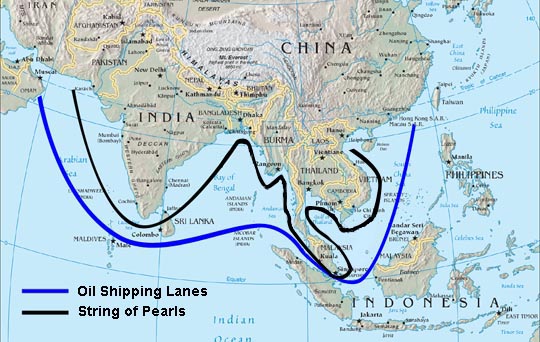
China, in recognition of the unique opportunities now available in SriLanka for the devt of the economy, will accelerate implementation of projects!!!
China hails advent of peace
Will fast track Hambantota Port development, China’s Commerce Minister tells Prof. Peiris in Beijing:
The Government of the People’s Republic of China, in recognition of the unique opportunities now available in Sri Lanka for the development of the economy, will accelerate implementation of the Hambantota port project and other major initiatives, China’s Commerce Minister Chen Deming assured Export Development and International Trade Minister Prof. G.L. Peiris at their meeting in Beijing.
The 75-minute meeting, which was attended by Sri Lanka’s Ambassador in China, Karunatilleke Amunugama covered a wide range of issues relating to co-operation between the two countries.
Prof. Peiris conveyed to the Chinese Government the warm appreciation of President Mahinda Rajapaksa for China’s consistent and vigorous support in safeguarding the sovereignty and territorial integrity of Sri Lanka and for the assistance given towards the welfare of displaced civilians. A consignment of tents worth RMB 20 million had been handed over in Colombo at the end of May, the Minister said, while China had also made a contribution of US$ 1 million.
Sri Lanka sought concessions to reduce the trade gap and to enhance trade volumes under the Asia Pacific Trade Agreement. As Sri Lanka’s major exports to China are a few products such as tea, spices, rubber products, coconut fibre, gems and jewellery, cosmetics, herbal products, handicrafts and fish, Minister Peiris urged concessions comparable with those enjoyed by ASEAN countries. He also suggested modalities for expanding the number of products in the preferential duty category.
Minister Peiris emphasised that the tea trade in Sri Lanka is eager to obtain an import quota for Sri Lankan tea to China at zero duty level.
Under the APTA regime, Sri Lanka tea is entitled to a preferential tariff of 7.5 percent.
He urged Chinese investors to reap the benefits of the flexible investment regime adopted by the Sri Lankan Government, especially in the context of the Northern and Eastern Provinces Re-awakening Program spearheaded by the Government for infrastructure projects relating to roads, housing, water, electricity and tourism.
Minister Peiris referred to the visit by President Rajapaksa to the Hainan Province in Southern China a few months ago to attend the Boao Summit, and to President Rajapaksa’s discussions on that occasion with Chinese President Hu Jin Tao at which both Prof.
Peiris and his Chinese counterpart were present. By way of follow up to that discussion, Prof. Peiris warmly thanked the Chinese Government for the valuable co-operation extended towards implementation of the Hambantota Port Development Project, the Puttalam Thermal Power Project and the Performing Arts Theatre.
He said that Sri Lanka looks forward to the benefits of technology transfer from China for product development through value addition, especially in the rubber and food processing sectors.
China’s Commerce Minister Chen Deming told the Minister Prof. Peiris that China greatly values her long and close friendship with Sri Lanka and that, in the post-conflict scenario now developing in Sri Lanka, closer collaboration in respect of the economy is entirely appropriate. He assured the Sri Lankan Minister that existing projects, especially those which would enable the benefits of peace to be realised in full, will be put on a fast track.
The Chinese Government, he added, is ready to receive from Sri Lanka proposals with regard to new projects which are now feasible in the transformed situation, together with an indication of priorities.
Prof. Peiris delivered a keynote address at the inaugural session of the Fourth China-South Asia Business Forum in Kunming, and was invited to unveil the ceremonial plaque at the launching ceremony.
58 business leaders from Sri Lanka participated in the South Asian Commodities Trade Exhibition.
dailynews.lk
Subscribe to:
Posts (Atom)